Who Is Responsible for Repairs in a Condo? Understanding Association vs. Owner Obligations

Who Is Responsible for Repairs in a Condo?

Written by Chris Abbott

April 30, 2026

Table of Contents

Share

Link copied to clipboard!

Determining who is responsible for repairs in a condominium is one of the most common sources of confusion—and conflict—in shared communities. Unlike single-family homes, repair responsibility in a condo is not based on assumptions or “common sense.” It is defined by the association’s governing documents and applicable Florida law, and those definitions can vary significantly from one community to another.

Common Elements vs. Unit Responsibilities

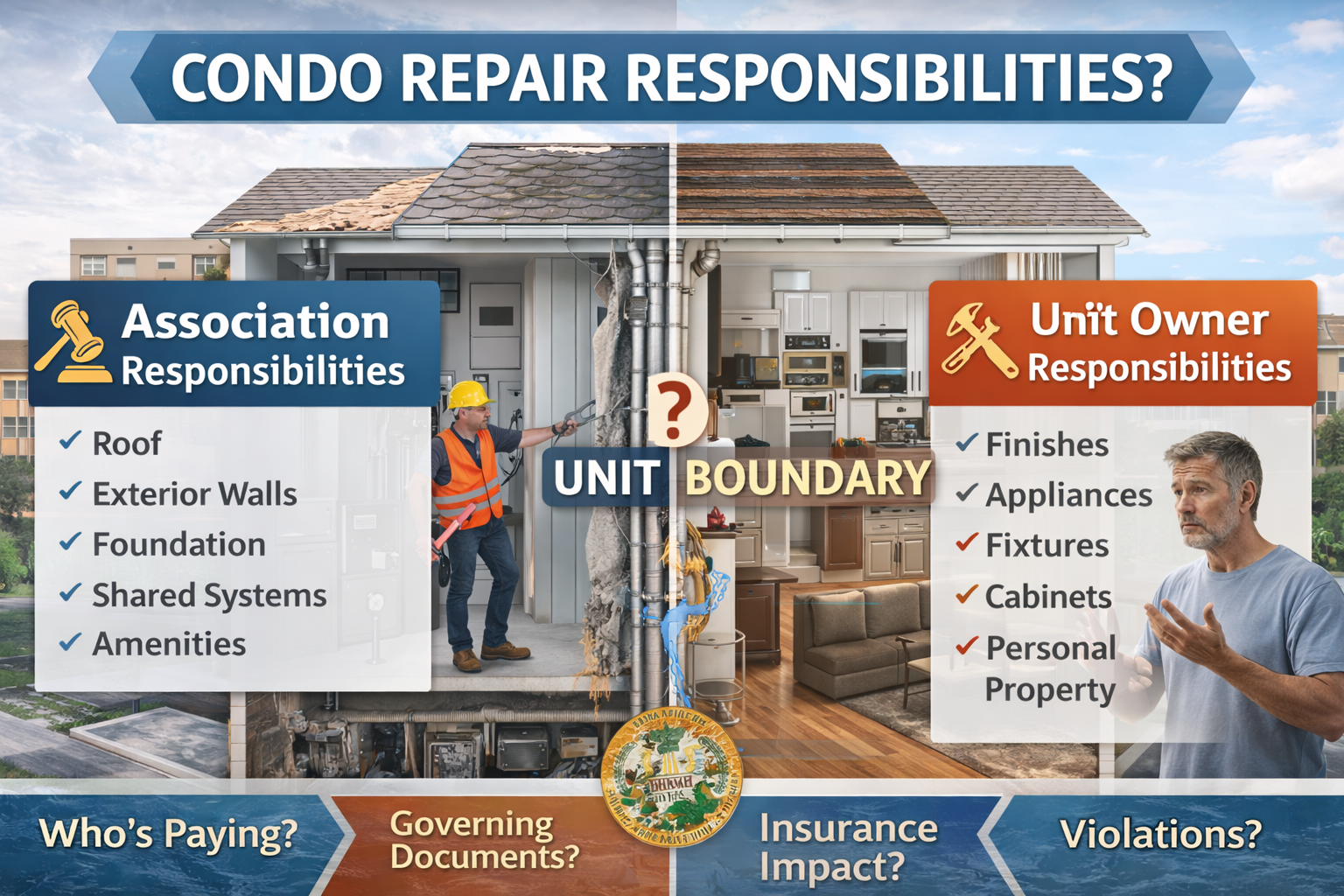
In general, condominium associations are responsible for maintaining, repairing, and replacing common elements. These typically include:

  • Roofs

  • Exterior walls

  • Foundations

  • Structural components

  • Shared plumbing or electrical systems

  • Common-area amenities

Unit owners, on the other hand, are usually responsible for maintaining the interior of their units, including:

  • Flooring and interior finishes

  • Cabinets and countertops

  • Appliances

  • Fixtures

  • Personal property

However, the exact division depends entirely on how the declaration defines “unit boundaries” and “common elements.”

The Gray Areas That Cause Disputes

Certain components often fall into gray areas, leading to disagreement. Plumbing lines, electrical wiring, windows, balconies, doors, and HVAC systems frequently raise questions about responsibility.

For example, a plumbing leak may originate inside a wall but serve multiple units. Is it the owner’s responsibility because it is inside the unit? Or the association’s responsibility because it serves more than one unit?

The answer depends on the language in the declaration—not the location alone.

Why Proper Interpretation Matters

Misunderstanding repair responsibility can result in:

  • Delayed repairs

  • Escalating damage and costs

  • Insurance claim complications

  • Strained relationships between owners and boards

  • Potential legal disputes

In some cases, unauthorized repairs by the wrong party may create liability exposure or even jeopardize insurance coverage.

Boards and owners should always consult the declaration, bylaws, and rules before assigning responsibility or authorizing work.

Consistency and Communication Are Key

Associations must apply repair responsibilities consistently. Inconsistent enforcement can lead to claims of selective treatment and legal challenges.

Clear communication also reduces tension. When repair issues arise, boards should explain not only who is responsible—but why that determination was made under the governing documents.

Ultimately, understanding repair obligations protects property values, controls costs, and preserves community harmony. When boards and owners rely on the governing documents and communicate openly, repair disputes can be resolved efficiently and with far less conflict.

Popular in the Community

aGVp03fc4bHWi-Lo_APM-HOA-President-Duties-blog
How to Choose the Right HOA or Condo President for Strong Community Leadership
Learn how to choose the right HOA or condo association president to ensure strong leadership, financial...

Learn more
shutterstock_2356241977
Choosing the Right Bank for Your HOA or Condo Association: What Boards Need to Know
Learn how to choose the right bank for your HOA or condo association, including key features like reserve...

Learn more
ChatGPT Image Mar 19, 2026, 11_47_23 AM
Best Property Management Software for HOAs and Condos: How to Choose the Right Platform
Discover how to choose the best property management software for HOAs and condos, including platforms...
Learn more