Copyright © Kaloop 2025 All Right Reserved
Best Property Management Software for HOAs and Condos: How to Choose the Right Platform
Written by Chris Abbott
July 16, 2026
Table of Contents
- Introduction
- What Smaller HOAs and Condos Should Look For
- What Larger Communities Need
- Why Transparency and Continuity Matter
- The Bottom Line
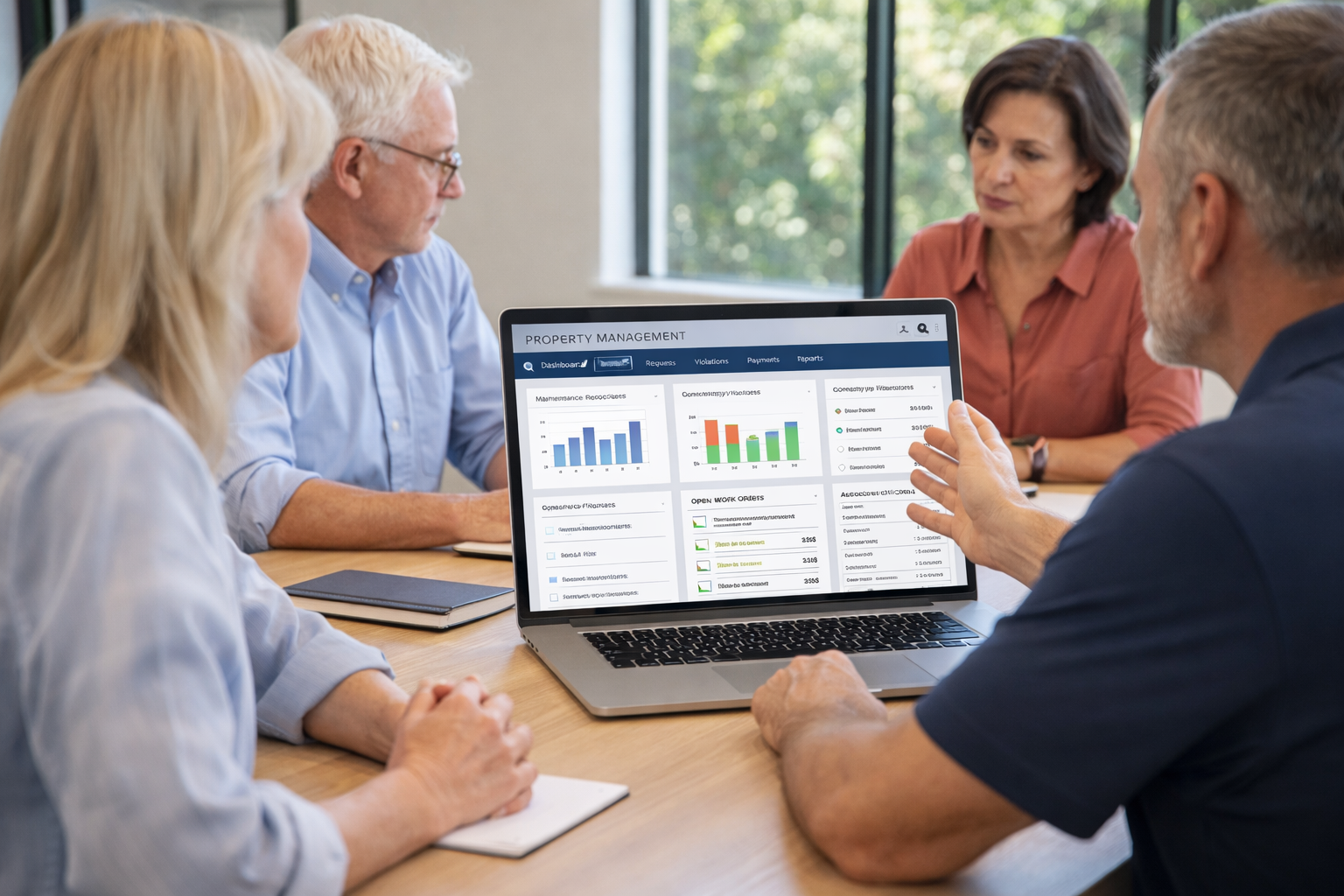
There is no single “best” property management software for every homeowners association (HOA) or condominium community. The right platform depends on the size of the association, the complexity of operations, and how boards and managers function day to day.
The key is choosing software that fits the community—not forcing the community to adapt to the software.
What Smaller HOAs and Condos Should Look For
For small to mid-sized communities, ease of use is often the most important factor. Boards benefit from platforms that simplify operations without requiring extensive training.
Key features to look for include:
Centralized document storage
Violation and work order tracking
Simple communication tools
Homeowner portals
Online payment capabilities
Modern platforms like Kaloop and similar HOA software solutions are designed to streamline these functions while keeping systems intuitive and accessible.
What Larger Communities Need
Larger or more complex associations often require more advanced functionality. These communities typically benefit from:
Robust accounting and financial reporting
Integration with banking and reserve planning
Compliance tracking tools
Enhanced data security
Scalability is critical. The software should grow with the community without creating confusion or operational silos.
Why Transparency and Continuity Matter
The best property management software does more than manage tasks—it preserves information. Board members and management companies change over time, but the system should maintain continuity.
A strong platform ensures:
Easy access to historical records
Organized communication logs
Clear financial tracking
Consistent operational workflows
This prevents information from being lost in emails, spreadsheets, or outdated systems.
The Bottom Line
The best property management software is not defined by the number of features—it is defined by how well it works for your community.
When software reduces friction, improves communication, and supports better decision-making, it becomes an essential tool rather than just another system.
When technology works quietly in the background, the entire community feels the benefit.
Popular in the Community
AI in Homeowners Associations: Smarter Communities, Less Stress

Written by Chris Abbott
June 9, 2026
Table of Contents
- Introduction
- Faster Communication, Fewer Headaches
- Better Maintenance Planning
- Fairer Rule Enforcement
- Technology with Boundaries
- The Bottom Line
Artificial intelligence is no longer limited to large tech companies. Today, AI is becoming a practical tool for homeowners associations (HOAs), helping boards and property managers streamline operations while improving the homeowner experience.
When used responsibly, AI can reduce administrative burdens and help communities operate more efficiently.
Faster Communication, Fewer Headaches
One of the biggest challenges for HOA boards is responding to frequent homeowner questions. AI-powered tools can help answer common inquiries instantly, such as questions about parking rules, amenity hours, payment reminders, or community policies.
Instead of waiting days for a response, residents receive quick and consistent information. This allows boards and property managers to focus on more complex issues rather than repeating the same answers.
Better Maintenance Planning
Maintenance is another area where AI can provide real value. By analyzing service requests, repair history, and vendor reports, AI tools can identify patterns that signal potential problems.
For example, repeated plumbing service requests or recurring lighting failures may indicate a larger issue that needs attention. Early detection allows associations to address maintenance concerns before they become costly emergencies.
Fairer Rule Enforcement
Rule enforcement can sometimes lead to disputes within a community. AI-powered tracking systems help associations document violations consistently by recording timelines, notices, and resolutions in a structured way.
This organized approach helps boards apply rules more evenly, reducing claims of selective enforcement and ensuring compliance with community policies.
Technology with Boundaries
While AI can improve efficiency, it does not replace board oversight or human judgment. Community associations still rely on board members to evaluate circumstances, communicate with residents, and make final decisions.
The most successful HOAs use AI as a support tool rather than a decision-maker, maintaining transparency and accountability.
The Bottom Line
AI is helping HOAs shift from reactive management to proactive community planning. By improving communication, organizing data, and identifying issues early, artificial intelligence can support smoother operations and better decision-making.
For modern community associations, thoughtful use of technology can lead to less stress for boards, clearer communication for residents, and stronger communities overall.