How to Request Changes or Variances in Your HOA

How to Request Changes or Variances in Your HOA
Written by Chris Abbott

May 12, 2026

Table of Contents

Share

Link copied to clipboard!

Living in a homeowners association (HOA) often means following established rules regarding exterior changes, landscaping, paint colors, fencing, and other property modifications. But what happens if you want to make a change that doesn’t strictly comply with those guidelines? That’s where a variance request comes in.

A variance is formal permission from your HOA to deviate from the community’s governing documents for a specific project. Common examples include installing a fence that exceeds height limits, adding a non-standard mailbox, modifying architectural features, or altering landscaping beyond typical guidelines.

Understanding the proper process can significantly improve your chances of approval.

1. Review the Governing Documents First

Before submitting any request, carefully review your HOA’s:

  • Declaration

  • Bylaws

  • Rules and regulations

  • Architectural guidelines

Identify exactly what is allowed, what requires approval, and whether variances are permitted. Submitting a request that clearly conflicts with governing authority may result in automatic denial.

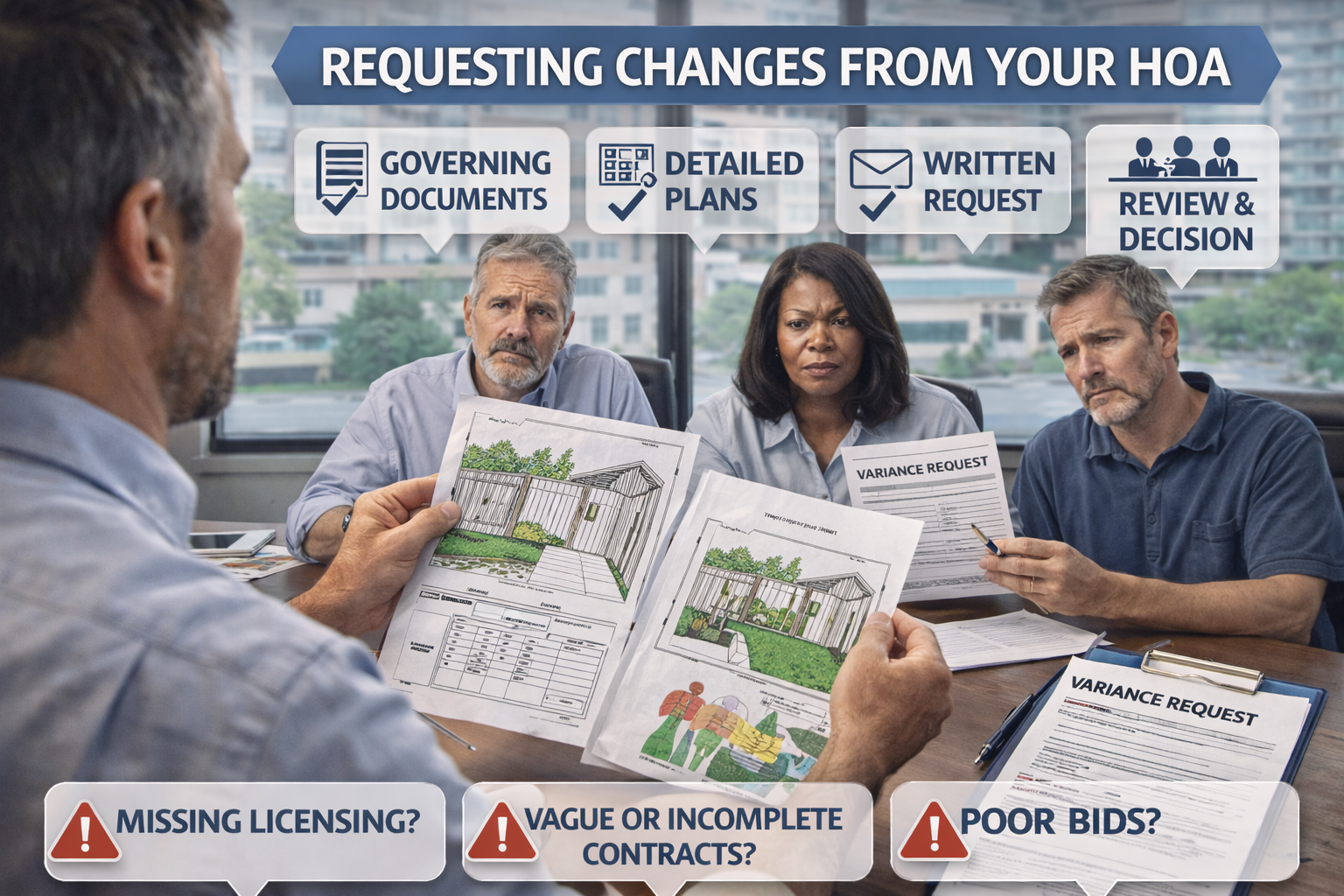
2. Prepare a Detailed Proposal

Boards and architectural review committees rely on clear documentation to make informed decisions. Your proposal should include:

  • Detailed plans or drawings

  • Dimensions and measurements

  • Materials and colors

  • Product specifications (if applicable)

  • Photos or renderings

The more complete your submission, the fewer delays you’ll experience due to follow-up questions.

3. Submit a Formal Written Request

Most HOAs require written submissions, often using a standard architectural or variance request form. Be sure to include all supporting documents and meet any submission deadlines.

Incomplete applications are a common reason for processing delays.

4. Follow the Review Process

Some associations require applicants to attend a board or architectural committee meeting. Be prepared to explain:

  • Why the variance is requested

  • How the change will impact neighboring properties

  • Why the modification maintains community standards

Boards may approve, deny, or approve with conditions.

5. Respect the Final Decision

If approved, comply with any stated conditions. If denied, you may be able to revise and resubmit your request with additional information or modifications.

Maintaining a respectful tone throughout the process helps preserve positive relationships within the community.

Popular in the Community

ChatGPT Image Mar 11, 2026, 03_51_10 PM
Wet Insulation in Condos and HOAs: The Hidden Damage Water Leaks Can Cause
Learn why wet insulation in HOA and condominium buildings can lead to mold, structural damage, and costly...

Learn more
ChatGPT Image Mar 11, 2026, 03_41_06 PM
Why Great Property Management Companies Are the Backbone of Successful HOA and Condo Communities
Discover why strong property management companies are essential for successful HOA and condo communities,...

Learn more
ChatGPT Image Mar 11, 2026, 03_23_57 PM
HOA Reserve Planning: How “Board Paralysis” Can Cost Communities Thousands
Learn how board hesitation on reserve studies can lead to costly repairs and special assessments in HOA...
Learn more